
Your providers were looking in the right place with the wrong tools.
You went in tired. You said so. They ran the labs. The labs came back normal. They told you that was good news.
It was good news. Normal labs ruled out disease. That matters. You needed that ruled out.
But ruling out disease is not the same as finding out why you can't get off the couch.
A smoke detector checks for fire. It doesn't check for cold.
Your labs were a smoke detector. They were built to catch the dangerous thing. They did their job.
Nobody handed your provider a thermometer. Nobody asked them to check whether the furnace was running at thirty percent — whether your body was still making the energy it's supposed to make. The test for that simply wasn't on the order.
It's not a miss. It's a different instrument for a different question.
Normal is not optimal.
"Normal" is a range built from everyone — the well and the unwell mixed together. It's wide enough to include a lot of people who feel terrible.
You can sit inside that range and still be running on empty. The number passes. You don't.
Normal is not optimal. And the distance between those two words is exactly where your exhaustion lives.
One number can't show you a shape.
Cortisol is supposed to rise in the morning and fall through the day. It has a curve. A single blood draw takes one point on that curve and calls it the whole story.
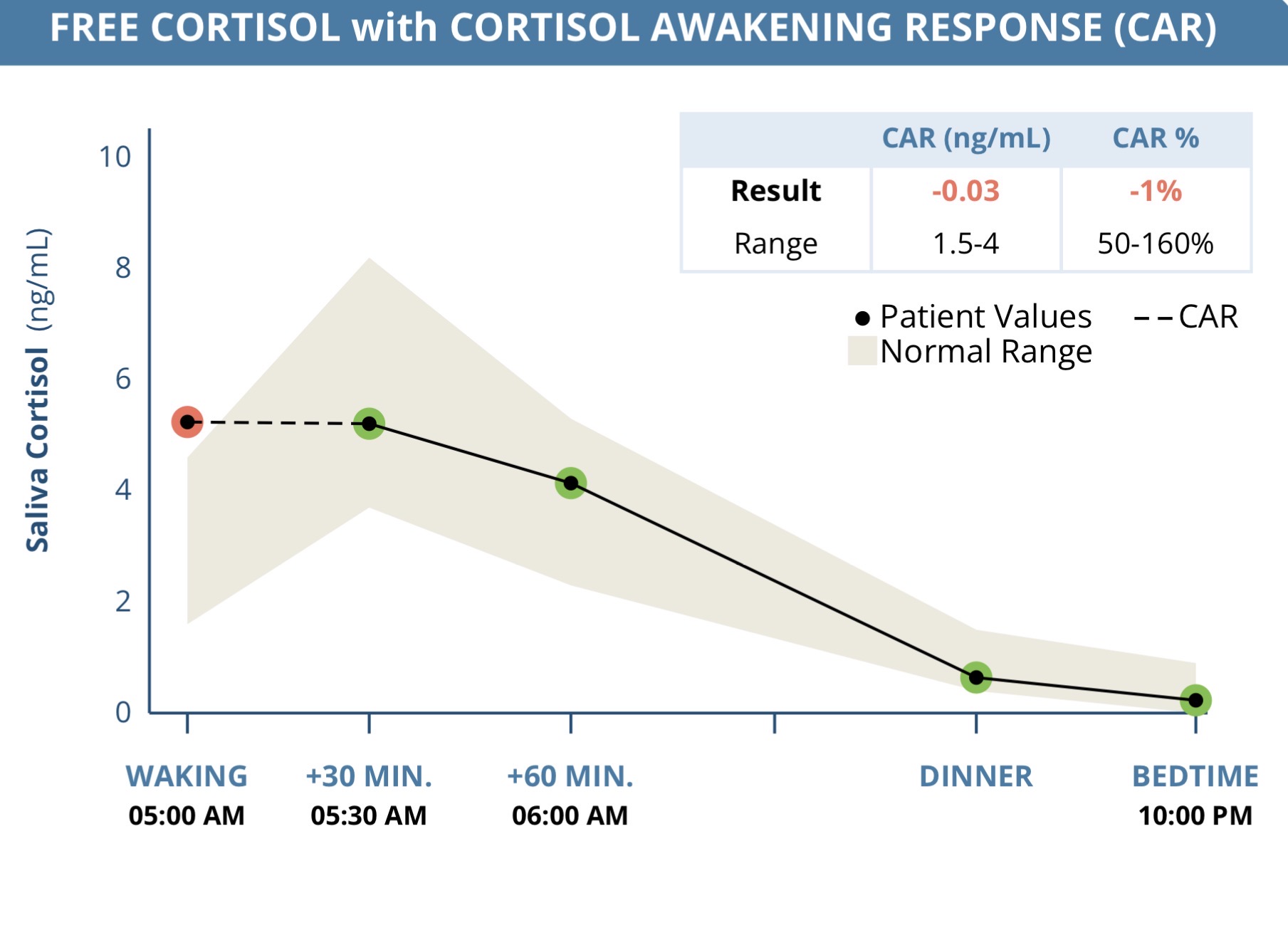
Most exhausted women have a normal cortisol number and a broken cortisol curve. On a blood test, those look identical.
The DUTCH Plus takes five points across one full day, at home, on your cycle. It draws the curve. Then we read it.
You didn't come this far to settle for normal.
Normal is not optimal. And the distance between those two words is exactly where your exhaustion lives.